

The Tension Between Being Visible and Being Effective
What years of leadership presentations, one gendered double standard, and a lot of invisible labor taught me about being seen.

For years, the most praised I ever was at work had almost nothing to do with the work.
It was after leadership presentations. Mine, or the ones I coached my team members through. Hours and hours of prep. Weeks of stress and rehearsed nerves, all in service of a moment in front of senior leaders who could not, or would not, meet the work at the level it actually lived at. They needed the pomp. The polished narrative arc. The clean slide with the clean story. And it was that performance, not the underlying work, that got remembered, funded, and rewarded.
Meanwhile, the actual work I was proudest of is never what got me recognized.
It looked like getting to know each person on my team well enough to understand what they wanted beyond what their job title or the org chart said they should want. It looked like knowing who needed a stretch opportunity and who needed to be protected from one. It looked like stepping back and letting someone lead when they were ready, and stepping in without complaint when they weren't. None of that had a slide. None of it made it into a promotion packet. It just made the teams I lead function as well as they could in the specific environment.
That gap between what gets seen and what actually works is the tension between being visible and being effective.
The work and the packaging of the work are not the same thing
We’re taught, early and often, that good work speaks for itself. That if we just do the work well enough, recognition follows naturally. It’s a comforting idea and it’s often not true.
The work itself is almost never linear. It’s messy, full of dead ends and learnings and built by people who are good at navigating ambiguity and finding a path through it. The packaging of that work is nothing like that though: the closest approximation of a straight line we can construct after the fact, polished up with the perfect words and the right visuals to evoke the right “powers-that-be” emotions, engineered to hide exactly how gnarly the process actually was.
Organizations don't reward the gnarliness. They reward the good story and the gorgeous visuals. And the people who get good at drawing straight lines aren't always the people who did the work. Often, they're the ones who talk the most, who need to be seen and heard more than they need to listen, who agree with whoever holds the most power in the room because agreement is currency. They're rarely held accountable for outcomes, because by the time outcomes are due, they've already claimed the win, spun the good story and moved on to the next room.
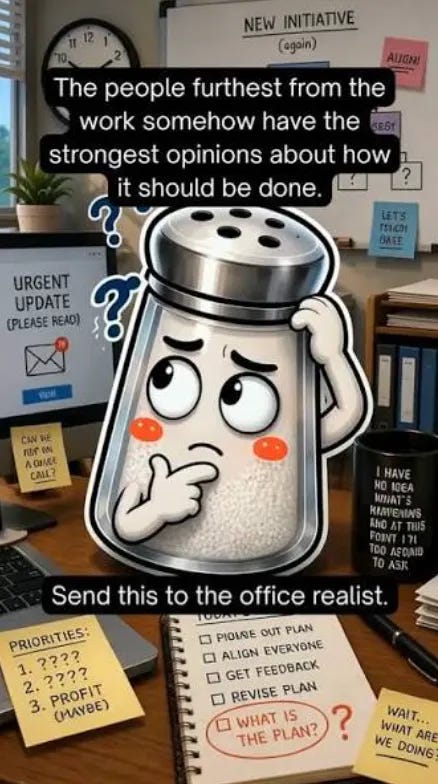
Meanwhile, the people doing the real, load-bearing work: absorbing the emotional weight of a team, holding steady in ambiguity while everyone else stalls, reading a room well enough to know what it actually needs, rarely get seen for any of it. They’re quiet because they’re paying attention, not because they have nothing to say.
The trap tightens further if you’re a woman
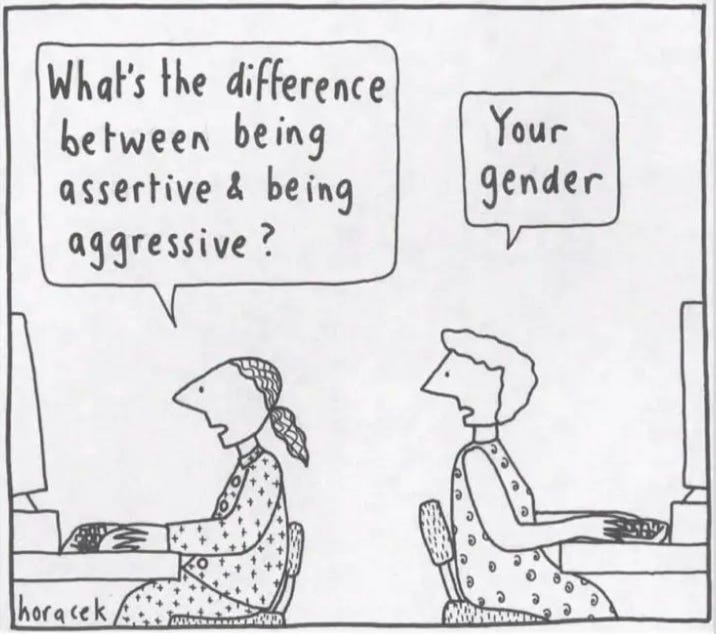
This tension doesn’t land the same way for everyone. For women, visibility carries a different price tag altogether.
Years ago, I was working with an offshore engineering team on a product experience that was deeply specific to the U.S. market. The team lacked the context to build it well, and the execution was so far off that I ended up writing much of the code myself and sending it over. This was happening while my son was going through multiple surgeries in his first year of life.
I built a case for bringing engineering local, sitting alongside design, with real cost savings attached. I took it to the senior leader who controlled the budget. I did the work and was assertive and showed the impact. I was turned down, and the feedback I received afterward was that I’d come across as too negative.
Not long after, a different leader, this one a man, brought the same request to the same person in a casual conversation, and it was approved.
I still don't fully understand how the same ask, made with more evidence and more rigor, read as aggression coming from me and reasonableness coming from him. But research on what's known as the double bind gives some language to it. Catalyst's well known research on women in leadership found that when women act in ways that read as warm and communal, the traits stereotypically expected of them, they're often seen as likable but not competent. When they act in ways that read as decisive and assertive, the traits associated with effective leadership, they're seen as competent but cold, difficult, unlikable. Women are rarely granted both at once. Men, largely, aren't asked to choose.
It's not that women can't win. It's that the win keeps moving depending on which trait is currently being punished.
The emotional weight
This tension shows up especially for people in caregiving-adjacent work: nurses, teachers, counselors, and honestly, a lot of the leaders I coach.
Their most effective moments are often invisible by design. A crisis that never happened. A kid who didn’t fall through the cracks because someone was paying close enough attention to catch it before it became a headline. Nobody shows the disaster that didn’t occur in the leadership presentation.
Researchers studying emotional labor, the ongoing work of managing feelings, relationships, and interpersonal dynamics in professional settings, have found it’s consistently linked to burnout, and that this labor falls disproportionately on women. It’s the same absorption I was doing for my team for years without it being officially part of my recognized responsibilities. My hypothesis, watching this pattern across my coaching clients, is that this invisible emotional load is a real driver of the burnout so many high achieving, human-centered leaders are buckling under right now. Because they’re carrying weight nobody’s counting or recognizing or even acknowledging.
Stepping back doesn’t always cost what you think it will
This isn’t a clean story where visibility always wins and invisibility always loses. It’s more nuanced than that.
Years ago, I was a principal designer helping grow a new team when a director role opened up, a role that would have made me someone’s boss again, and I thought that’s what I wanted. I started the application, then withdrew it and asked instead to sit on the panel that would hire my future boss. My son had a heart surgery coming, and I knew I didn’t have the capacity to take on a director role at that moment.
The person we hired went on maternity leave a few months later. I stepped in as interim, grew the team, and when she returned, the team split and I moved into a director role anyway, shortly before my son’s surgery. She became one of my closest friends and one of the best bosses I’ve had. She was the one who told me I was underpaid, fought to correct it, and taught me how to advocate for myself. Having her as a partner made stepping into that role, at that moment, feel survivable and I don’t believe it would have otherwise.
Stepping back didn’t cost me what I feared it would. But it also wasn’t neutral. It required someone else in my corner, willing to see the work I was capable of even when I wasn’t the one putting myself forward for it.
Since going independent, the tension hasn't disappeared
I left corporate for the autonomy, and the autonomy has been worth it. But the marketing side of building something independently is its own version of this same tension, and I still don’t love it.
I know I've undersold myself trying to bring in clients. I know I'm still figuring out where and how to be seen honestly. If I had my way, I'd be doing deep one-on-one coaching work with 10-12 clients, alongside strategic consulting with mature leaders who understand what it actually takes to get things done, people who don't need the polished deck to take the work seriously (working on manifesting this into reality). I'm glad to tell the story of what we're solving and why on the consulting side. I just don't think it has to come wrapped in bullsh*t pomp and circumstance in order to see the value.
And I don’t think it’s asking for too much.
Where this leaves us
The answer isn’t to become more visible, and it isn’t to keep your head down and hope the work speaks for itself. Both of those put the burden back on the individual to solve a problem the structure created.
The more useful distinction might be this: there’s visibility as performance, built around narrative and polish and being legible to whoever holds power in the room. And there’s visibility as honesty, choosing to let your actual work be seen, on your own terms, without translating it into something it isn’t.
The soft rebellion isn't refusing to be seen. It's refusing to let the packaging replace the truth of what the work actually took. Sometimes that looks like naming it yourself and finally taking the credit you've earned. Sometimes it looks like telling a friend or coworker who understands exactly what it cost you. And sometimes it looks like finding the person who will say your name in the room you weren't invited into.
If you’re looking for somewhere to start, it might be this: name one piece of invisible work you did this month, that thing that didn’t make it into a summary or slide. Not to turn it into a pitch necessarily. Just to see it clearly yourself first, before you decide who else needs to.
When you're ready, here's how I can support you
If this piece named something you’ve been carrying, you don’t have to sit with it alone.
Book a discovery call
A conversation to get to know each other and talk through whether coaching is the right fit right now. This might be for you if:
You’re exhausted by doing everything right and still feeling unseen for it
You’re carrying the emotional weight of a team, a family, or both, and nobody’s naming it as work
You’re sensing it’s time for something to shift, but you’re not sure what that looks like yet
You want a thinking partner, not another person telling you to just push through
Or, maybe you just want to compare stories and get to know each other, that’s cool too.
[Book a discovery call →]
Coaching, priced by you
For a limited run, I’m opening a small number of pay-what-you-can sessions, starting at $30. Same coaching I usually charge $250 to $400 an hour for, not a stripped down version of it. Each session is 50 minutes, live, one sitting, with a recap afterward. Pick what fits where you are right now:
Clarity Session: you’re stuck on one decision or one tension, and you want to leave with a clear next step
Reset Session: you’re overwhelmed or running on empty, and you want one real shift for the week, not another thing to track
Strategy Sprint: you have one specific work problem or conversation, and you want to coach it in real time so you can act right after
Something Else: not sure which fits? Tell me what’s going on and I’ll meet you there
You can book up to two sessions at this rate before it moves to a standard coaching package.
[Book your pay-what-you-can session →]
The Fear Buster Series
Three live sprints from The Glimmer Network, built with my good friend, trusted advisor and cofounder Alison Gretz, for anyone ready to get their agency back. We’ve already passed Your Freedom Number, but if you register for all three, you’ll get the recording of that sprint along with everything still ahead:
Mind the Gap: Aug 13, 11am–12:30pm CT, with a live Q&A Aug 27
Beyond the Title: Sept 10, 11am–12:30pm CT, with a live Q&A Sept 24
Each sprint is $25 and stands on its own. Or register for all three for $60 (a $15 savings), which includes every recording, including Your Freedom Number.
[Explore the Fear Buster Series →]
How I use Ai
I want to be transparent about my Ai use as part of my writing process.
When a topic arises that I feel passionate about
I write stream of consciousness about my experience and do not focus on organizing my thoughts with any kind of coherence.
I use Claude and Google to identify research about my topic and then review and summarize what I find to be relevant.
I ask Claude to help me organize my thoughts with a prompt that guides the cohesive story I want to tell.
I go through and rewrite sections, remove, add, adjust and ensure nothing was taken out of context.
I respect those who choose to avoid writers using Ai. For now, this is part of my process and I will continue to update this as that process changes.
I feel this in my soul!